
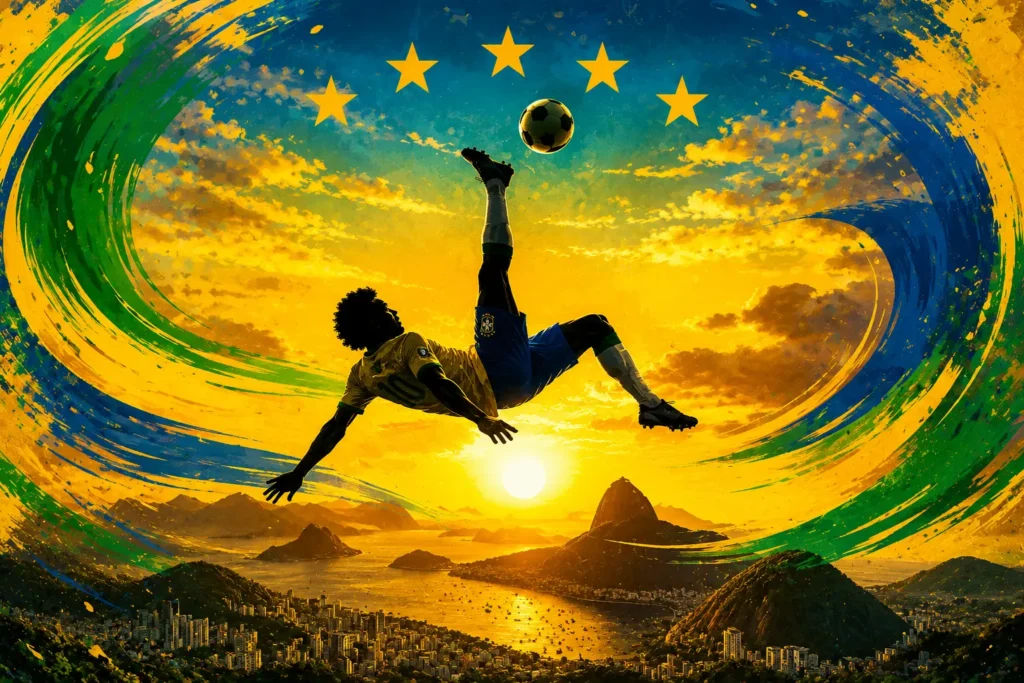

When exploring the history of brazil’s world cup football, a singular golden image instantly comes to mind: a sea of vibrant yellow shirts carving through defenses with effortless grace. This rich sporting legacy isn’t just a timeline of tournament statistics. Instead, it is the poetic chronicle of how a nation transformed a tactical sport into a cultural art form known globally as Jogo Bonito—the beautiful game.
For nearly a century, the South American giants have carried the immense weight of a soccer-obsessed population, turning high-stakes athletic pressure into moments of pure joy that have captivated fans across every continent. Staying at the top, however, has become increasingly difficult—challenged by evolving European tactics, intense media pressure, and rising global competition.
This comprehensive guide pulls back the curtain on how the Brazil national football team built the most dominant legacy in sporting history, tracking their journey from the teenage magic of Pelé to their modern tactical reinventions.
Statistical Overview: The History of Brazil’s World Cup Football By The Numbers
Before diving into the historical narratives, the data-driven table below offers a quick snapshot of the landmark eras, records, and milestones that define the history of brazil’s world cup football.
| Tournament Era / Metric | Key Achievements & Historical Significance | Legendary Figures & Icons |
|---|---|---|
| Total Championship Titles | 5-Time Global Champions (1958, 1962, 1970, 1994, 2002) | Pelé, Garrincha, Romário, Ronaldo Nazário |
| Tournament Attendance | The only nation to play in all 22 World Cups (1930–2022) | Cafu, Thiago Silva, Neymar Jr. |
| 1958 Sweden | First international title; youngest goalscorer in final history | Pelé, Vavá, Didi, Mário Zagallo |
| 1962 Chile | Back-to-back world champions; triumph over severe adversity | Garrincha, Amarildo, Zito |
| 1970 Mexico | Perfect qualification and tournament run; permanent trophy retention | Pelé, Jairzinho, Tostão, Carlos Alberto |
| 1994 United States | Ended a 24-year drought; first final decided by a penalty shootout | Romário, Bebeto, Dunga, Cláudio Taffarel |
| 2002 South Korea/Japan | Perfect seven-win campaign; redemption arc for the history books | Ronaldo, Rivaldo, Ronaldinho, Roberto Carlos |
| All-Time Record (As of 2022) | Most wins in World Cup history (76 victories) | Managed by the Confederação Brasileira de Futebol (CBF) |
These legendary numbers outline a rich culture built on victory. To understand how this unparalleled dominance was forged, we have to look back at the early heartbreaks that shaped the team’s relentless drive.
The Early Eras and the Maracanazo Heartbreak (1930–1954)
The journey of the Seleção began in 1930 as one of the original trailblazing nations in the inaugural tournament in Uruguay. While those earliest editions yielded mixed results—including a frustrating first-round exit against Spain in 1934—the squad quickly earned a reputation for free-flowing, highly improvisational attacking play.
Legendary striker Leônidas, nicknamed the “Black Diamond,” captured the world’s imagination during the 1938 tournament by finishing as the top scorer with seven goals. His brilliant overhead bicycle kicks laid the conceptual bricks for the rhythm and flair that would define Brazilian soccer.
Everything seemed perfectly aligned for a crowning national achievement when the country hosted its first tournament in 1950. A colossal new sporting cathedral, the Maracanã, was erected in Rio de Janeiro to welcome nearly 200,000 expectant fans for the final match against Uruguay.
Brazil needed only a draw to lift the trophy, but a shocking, late 2-1 defeat silenced the entire stadium and plunged the nation into mourning. This historical trauma, forever known as the Maracanazo, deeply altered the country’s psychological relationship with the sport and prompted a total aesthetic reinvention. This included permanently discarding their original white match kits for the iconic yellow and green shirts we recognize today.
This profound national heartbreak set the stage for an explosive structural rebirth. The lingering pain of 1950 directly fueled a tactical and scouting evolution that would soon unleash the greatest football prodigy the world had ever seen.
How Pelé Led Brazil to Three World Cup Titles (1958–1970)
The absolute golden age in the history of brazil’s world cup football kicked off in 1958 on the icy pitches of Sweden, powered by a pioneering 4-2-4 formation and an unknown 17-year-old phenom. Pelé became the youngest player to score a goal in tournament history, netting a brilliant hat-trick in the semi-final against France and two spectacular goals in the 5-2 final victory over the host nation. This breakthrough win shattered the myth that South American artists couldn’t adapt and win on European soil.
Severe injury sidelined the young talisman early in the 1962 campaign in Chile, but the brilliant, unpredictable winger Garrincha stepped up with some of the most mesmerizing dribbling displays ever witnessed to carry the nation to back-to-back championships. After a highly physical and disappointing group-stage exit in 1966, the team returned in 1970 with a squad widely considered the ultimate collection of footballing talent ever assembled.
Under the visionary management of Mário Zagallo, superstars like Jairzinho, Tostão, Rivelino, and Pelé won every single match in Mexico. They capped it off with a 4-1 tactical masterclass against Italy to secure their third title and the right to keep the original Jules Rimet Trophy permanently.
A Turning Point in the History of Brazil’s World Cup Football
The 1970 tournament is widely viewed as the zenith of the history of brazil’s world cup football. It proved to the world that beautiful, attacking soccer could simultaneously be ruthlessly efficient.
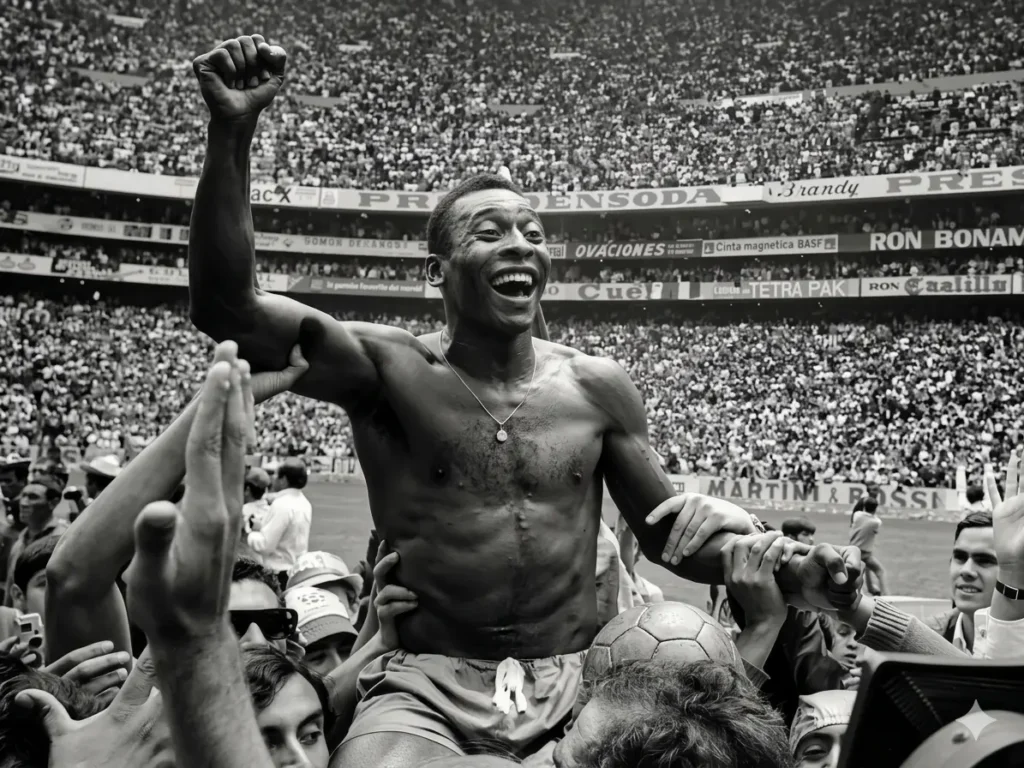
These historic triumphs permanently linked the country’s global identity to footballing perfection. However, as European teams grew highly organized, physical, and defensively disciplined, the dynamic South Americans had to endure a long, challenging path back to the podium.
The Modern Revival: Redemption in 1994 and 2002
Twenty-four years of mounting pressure and agonizing near-misses finally ended at USA 1994, an era that added a deeply defensive chapter to the history of brazil’s world cup football. The team showcased a distinct shift toward European-style tactical discipline and defensive stability.
Led by the lethal, telepathic strike partnership of Romário and Bebeto, alongside a rock-solid midfield captained by Dunga, they ground out results through incredibly tight knockout rounds. The intense final against Italy ended in a scoreless deadlock, leading to the first penalty shootout in a final match, where a dramatic final miss by Italy’s Roberto Baggio sealed a historic fourth star for the South American powerhouse.
The peak of modern football redemption arrived eight years later at the 2002 tournament in South Korea and Japan, cementing a legendary comeback in the history of brazil’s world cup football. Striker Ronaldo, who had suffered an agonizing medical emergency hours before losing the 1998 final to France, returned to the grandest stage completely unstoppable.
Supported by the creative geniuses Rivaldo and Ronaldinho, the legendary “Three Rs” tore defensive lines apart. Ronaldo scored both goals in the 2-0 final victory over a resolute Germany, capturing an unmatched fifth world title with a flawless record of seven consecutive wins.
This landmark fifth star cemented their place as the ultimate tournament specialists. In the decades following that historic night in Yokohama, however, the team has faced a new era of tactical challenges in their quest to maintain global supremacy.
Why Has the Title Eluded the Seleção Since 2002?
The recent chapters in the history of brazil’s world cup football have been defined by frustrating exits in the knockout stages against heavily organized European opponents. Despite consistently producing elite, world-class individual talents like Kaká, Neymar Jr., and Vinícius Júnior, the team has repeatedly struggled to break down rigid, compact defensive low-blocks.
The absolute nadir of this modern era occurred during the 2014 tournament on home soil, where an injury-depleted squad suffered a staggering, historic 7-1 semi-final loss to Germany’s relentless high-press system in Belo Horizonte.
Subsequent campaigns under manager Tite highlighted a recurring structural problem in the modern history of brazil’s world cup football. In 2018, Brazil struggled against Belgium’s lethal, transition-based counter-attacks, resulting in a narrow 2-1 defeat. The 2022 tournament in Qatar exposed further vulnerabilities when Croatia utilized a disciplined low-block defense and masterclass midfield control to eliminate Brazil on penalties.
Tactical analysts point out three main reasons for this prolonged tournament drought:
- Isolation from Elite Competition: A lack of regular, high-stakes competitive friendlies against top-tier UEFA national teams between tournaments has slowed down tactical adaptation.
- Over-reliance on Individualism: The squad has frequently defaulted to individual brilliance, leaving world-class defensive anchors like Casemiro and goalkeepers like Alisson exposed during rapid counter-attacks.
- Psychological Scars: The immense pressure of the 2014 collapse continues to weigh heavily on subsequent generations during high-stress knockout matches.
To bridge this gap, the FIFA powerhouse federation has integrated elite European structural discipline into a balanced, fluid 4-3-3 system that maximizes explosive young talents like Endrick. The goal is simple: blend traditional street-styled creativity with modern defensive pressing to rewrite the contemporary history of brazil’s world cup football and finally secure that elusive sixth star.
Strategic Topic Clusters for Further Reading
To explore the finer details of this rich sporting legacy, dive into our dedicated deep-dive resource hubs:
- [Internal Link: Link to your URL] Tactical evolution of Brazilian football (1958–2022): A comprehensive look at how tactical systems shifted from the 1958 4-2-4 layout to modern hybrid models.
- [Internal Link: Link to your URL] Complete profiles of Brazil’s World Cup legends: In-depth career retrospectives detailing the tournament impacts of Pelé, Garrincha, Romário, and Ronaldo.
- [Internal Link: Link to your URL] The historic football rivalry between Brazil and Argentina: Analyzing the fierce, decades-long battle for South American supremacy.
- [Internal Link: Link to your URL] The Maracanazo history and its cultural impact: A historical study on how the tragic 1950 defeat reshaped Brazilian culture, psychology, and national identity.
Frequently Asked Questions About the History of Brazil’s World Cup Football
How many times has Brazil won the World Cup?
Brazil has won the tournament a record five times. Their championship victories occurred in 1958 (Sweden), 1962 (Chile), 1970 (Mexico), 1994 (United States), and 2002 (South Korea/Japan). No other nation has matched this five-star achievement.
Has Brazil ever missed a World Cup tournament?
No, they have never missed a single tournament. They hold a flawless qualification record, appearing in all 22 editions from 1930 through 2022, and have consistently secured their spot through the grueling South American qualifiers.
Who is the top goalscorer for Brazil in tournament history?
Ronaldo Nazário is the top scorer for the country at the finals, scoring 15 goals across his brilliant career. He held the absolute global tournament record until it was broken by Germany’s Miroslav Klose in 2014.
What was the worst defeat in the history of brazil’s world cup football?
Their most severe defeat occurred on July 8, 2014, when they lost 7-1 to Germany in the semi-finals on home soil. This surpassed their previous worst margin of defeat, which was a 3-0 loss to France in the 1998 final match.


Been using this for a few weeks now and it has been a game changer for my daily routine. Highly recommended as a reading platform.
Great content! Keep up the good work!